Stop sanding defects before they reach clear coat.
A controlled sanding workflow that removes contamination at the source, shortens sanding time, and produces consistent finishes with significantly less rework.
A controlled sanding workflow that removes contamination at the source, shortens sanding time, and produces consistent finishes with significantly less rework.
30% faster throughput · Up to 1,080 labor hours recovered per year · 0.6 FTE freed for billable work
Figures reflect a typical three-technician bodyshop prep bay after workflow implementation. Calculate your shop-specific numbers below.
Dust isn't the hidden cost. Rework is.
In most bodyshops, dust is treated as part of the job. The real problem is what dust causes: it moves through preparation, sanding, and final cleaning, and only reveals itself after clear coat — as dirt inclusions, scratch marks, and extra polishing hours.
By that point, you're not fixing dust. You're fixing symptoms. And paying a technician to finish the same panel twice.
Traditional vs controlled sanding (two-column comparison)
Traditional sanding
- Panels sanded without prior cleaning or degreasing
- Dust returns to the surface after clear coat
- Abrasives load up and stop cutting at specification
- Polishing and finishing expand to absorb the defects
- Small corrections quietly steal capacity from the next job
Controlled sanding
- Surfaces are contaminant-free before the first disc touches
- Abrasives cut consistently from the first panel to the last
- Dust is captured at the tool, before it spreads
- Polishing becomes an exception, not a daily routine
- Output is predictable, repeatable, and technician-independent
This isn't a product problem. It's a process-control problem — and the cost compounds every shift.
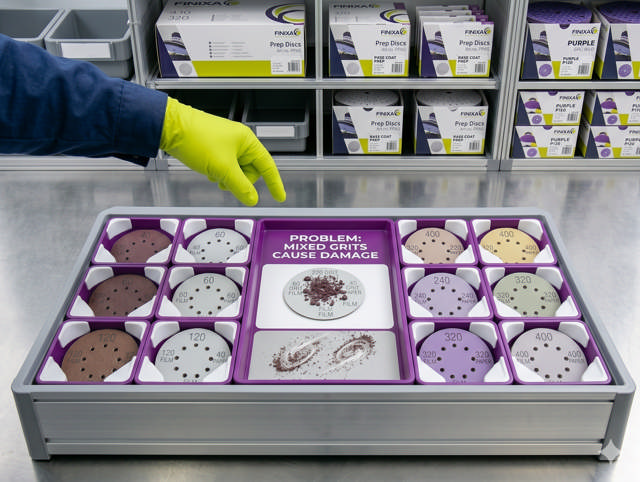
The three layers that decide a clean finish.
Every avoidable defect starts in one of three layers. When one fails, the next has to compensate and cost climbs with every step of compensation. Control these three. Downstream rework largely disappears.
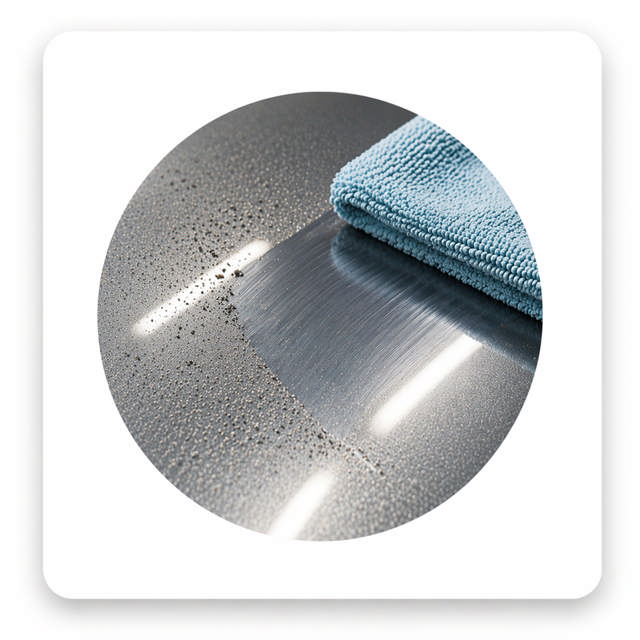
1. Surface preparation
Clean, degrease, and neutralize static before sanding begins. This is where 70% of downstream defects are prevented or created.
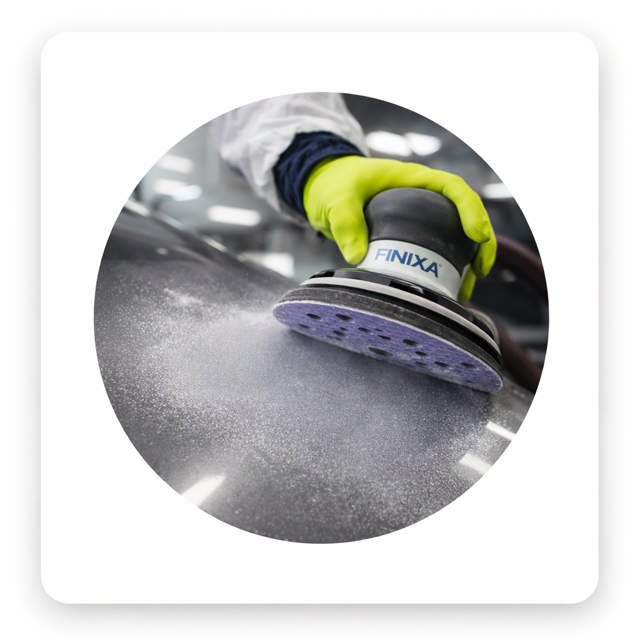
2. Sanding system
Cut and refine with abrasive grades and tools matched to the task, without generating visible scratch patterns or heat damage.
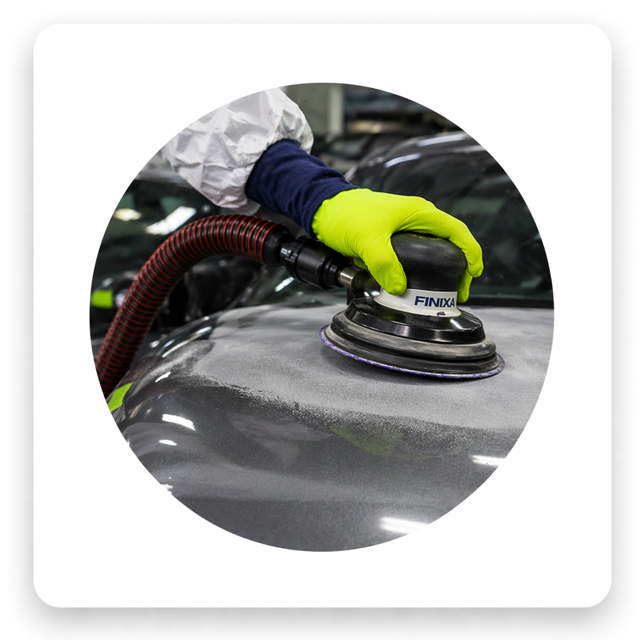
3. Dust extraction
Capture particles at the source, continuously, before they migrate across the panel and the workspace.
Where rework is actually won: surface preparation.
If the surface isn't clean, stable, and anti-static, every next step becomes compensation work.
Grease, silicone, fingerprints, and static turn the panel into a dust magnet. Once sanding starts, that contamination spreads, increases adhesion risk, and multiplies polishing time. The defects don't show up at the workstation — they show up hours later, after the panel has already moved on.
High-performing shops remove contamination at the source. And they do it before the first disc touches the panel.
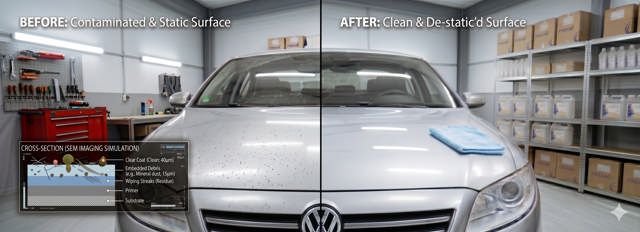
The preparation layer, in two steps.
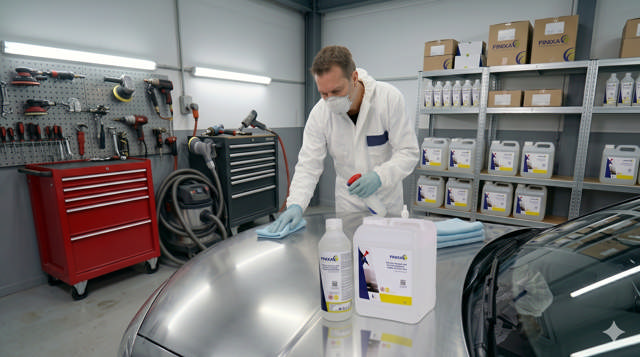
Silicone Remover & Surface Degreaser (DGRHC)
Removes silicone, grease, wax, fingerprints, and sanding residue before they become adhesion or contamination defects. Formulated to evaporate clean without leaving the attraction-causing residue that generic solvents often do.

TAK 20-30 Anti-Static Tack Rags
Neutralize static, lift residual dust, and hold the panel at a neutral charge until abrasive contact. The tack rag grade matters here — low-performance rags re-charge the surface instead of clearing it, which quietly guarantees rework later.
Together, these two steps decide whether the next ninety minutes of sanding are controlled or reactive.
The controlled sanding workflow, step by step.
High-performing bodyshops don't rely on individual technique. They standardize the process — so the outcome doesn't depend on which technician is on shift.
Step 1 — Prepare the surface
Clean, degrease, neutralize static. Contamination is removed before any abrasive work begins. Enabled by: DGRHC, TAK 20-30
Step 2 — Fast cut with ceramic abrasives (SPDI)
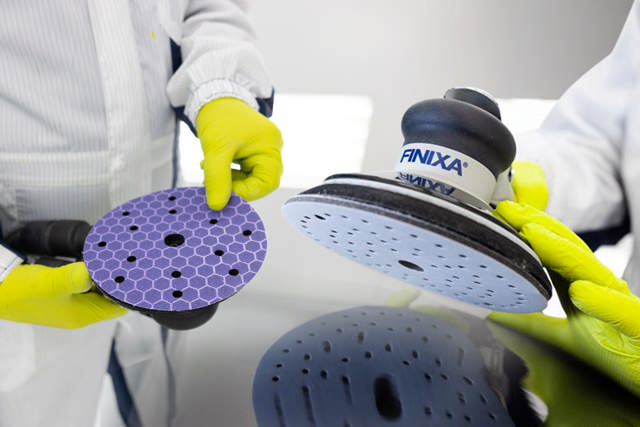
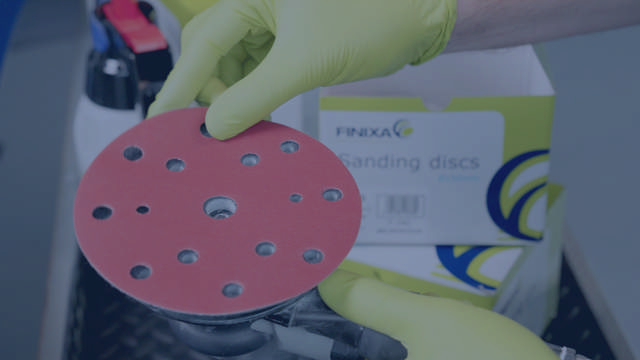
Controlled material removal without heat build-up or abrasive loading. Discs stay cutting at specification throughout the job, not just the first ten panels. Enabled by: Finixa SPDI Purple Ceramic discs
Step 3 — Keep dust down while sanding
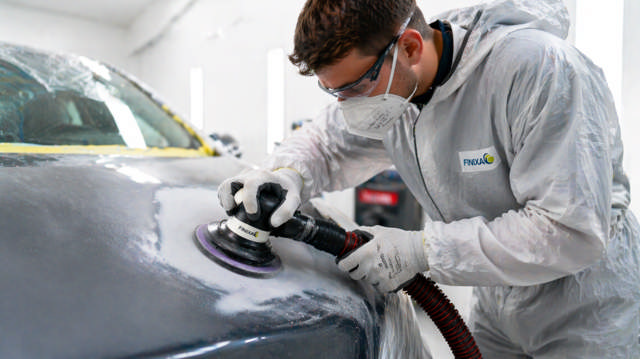
Source extraction is connected at the tool, so particles are captured at the point of creation — not after they travel across the panel and into the next coat. Enabled by: Hamach HCV 5000 TQ
Step 4 — Refine with PPAS
Step down through the abrasive grades to produce a refinement surface that hides scratch patterns under direct light and reduces polishing load afterward. Enabled by: Finixa PPAS refinement system
Step 5 — Final clean before coating
Degrease and stabilize once more before primer or base coat. This is the last opportunity to remove what sanding has put back. Enabled by: DGRHC, CMV B-M EA/PA mobile vacuum cleaner
What it actually costs when the process isn't controlled.
Rework rarely shows up as a line item. It hides inside extra prep time, second rounds of polishing, repeated cleaning, and non-paint consumables that quietly accumulate across the week.
On a typical three-technician prep bay, uncontrolled sanding absorbs:
- 10-15 additional minutes per panel in polishing and correction
- 2-3 extra cleaning passes between coats
- Up to 0.6 FTE of labor consumed by rework that shouldn't exist
- One repair per technician per week of lost throughput capacity
None of this appears in a product line item. All of it appears in your margin.
The question isn't whether your shop has this cost. It's how much of it — and what you'd do with the capacity you'd get back.
See what controlled sanding is worth in your shop.
Three inputs. Shop-specific output. No signup required.
Your range assumes workflow-level implementation across preparation, sanding, and extraction. Individual step improvements produce partial returns.
Average sanding time per repair: 3 hours Potential efficiency gain: up to 30% Potential annual savings: 1080 hours Equivalent labor savings: 0.6 FTE
Estimate your time and labour savings
Based on your current repair volume, your process assumptions.
Based on Finixa 2-Step System vs. traditional sanding, calculated over 240 working days.
Prova la differenza!
Contattaci o richiedi una demo oggi stesso e scopri come il sistema in 2 fasi Finixa può trasformare il tuo flusso di lavoro.
Dust extraction is the backbone of process control.
Dust is the variable that connects every other step. If extraction fails, the rest of the workflow fails with it — regardless of how well the surface was prepared or which abrasive is on the machine.
Industrial extraction does three things that shop vacuums and mobile units cannot:
- Hold airflow and suction steady across long sanding runs
- Keep the workspace pressure-neutral so dust doesn't migrate between bays
- Support multiple technicians simultaneously without performance drop-off
This is why continuous dust control — not intermittent capture — is what separates a finish-first shop from a polish-first shop.
Mobile Vacuum Cleaner CMV 8-M EA/PA
Dust-free work is important for the health of your employees and the quality of your paint work. This compact and powerful Mobile Vacuum Cleaner helps you to remove fine dust produced by sanding and keeps your workspace clean. It is suitable for dry and liquid suctioning.
.png&width=640&format=webp)
Remove dust at source before it becomes finishing work
Without proper extraction, even good abrasives and good technique lose consistency.
Dust is the variable that connects every other step. If extraction fails, the rest of the workflow fails with it — regardless of how well the surface was prepared or which abrasive is on the machine.
Industrial extraction does three things that shop vacuums and mobile units cannot:
- Hold airflow and suction steady across long sanding runs
- Keep the workspace pressure-neutral so dust doesn't migrate between bays
- Support multiple technicians simultaneously without performance drop-off
This is why continuous dust control — not intermittent capture — is what separates a finish-first shop from a polish-first shop.
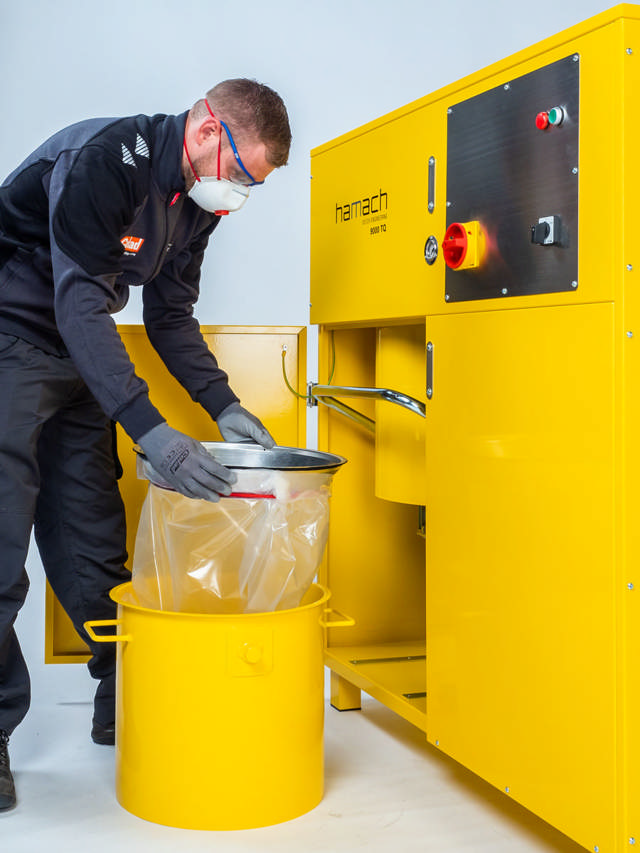
Hamach HCV 5000 TQ
Engineered for continuous operation in high-throughput bodyshops. Supports multiple sanding tools without airflow loss, keeps noise low enough for high-performance shops to run uptime through a full shift, and cleans its own filters automatically during downtime. This isn't a shop vacuum. It's the infrastructure layer of a controlled sanding bay.
See the workflow in a working shop.
Watch the full sequence — surface preparation, sanding, extraction, final clean — in a bodyshop running the controlled workflow. The real question the video raises is the one worth taking back to your floor: what would this look like in your bay?
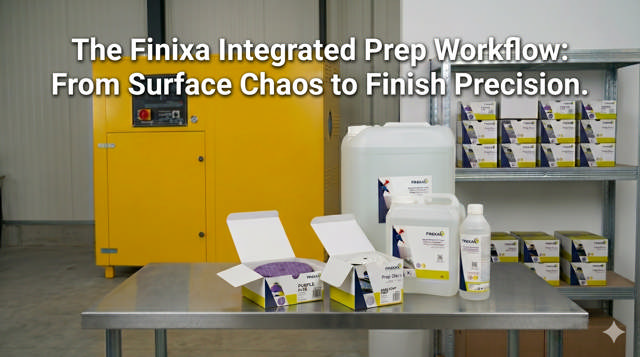
This is what a controlled sanding process looks like in practice. The next question is what it is worth in your shop.
Frequently Asked Questions
What causes dust nibs after clear coat? Dust nibs are particles that settle into the paint film before it cures. Most originate earlier in the process — during sanding, cleaning, or preparation — not during paint application. Controlling contamination at the preparation and sanding stages removes the root cause rather than correcting it afterward.
What is sanding rework? Sanding rework is any additional labor spent correcting a panel after sanding or painting should have been finished. It includes repeated polishing, second-pass cleaning, re-sanding of visible defects, and compensation work done to mask issues created upstream.
How can bodyshops reduce sanding defects? By controlling three layers: surface cleanliness before sanding, abrasive and tool selection during sanding, and continuous dust extraction at the source. Defects are dramatically reduced when all three are standardized — not left to individual technique.
Why do sanding discs clog? Discs clog when material, heat, and contamination load onto the abrasive faster than it can clear. The most common causes are uncleaned surfaces, undersized or disconnected extraction, and abrasive grades that aren't matched to the task or substrate.
What is the best sanding process before painting? A controlled workflow that starts with degreasing and anti-static treatment, progresses through ceramic fast-cut and fine refinement, and runs continuous source extraction throughout. A final clean immediately before coating prevents reintroduced contamination from becoming a defect.
What is surface preparation in bodyshop work? Surface preparation is the step in which a panel is cleaned, degreased, and stabilized before any abrasive work begins. Done properly, it removes silicone, grease, fingerprints, and static — the contaminants that cause the majority of downstream defects.
What is industrial dust extraction? Industrial dust extraction is the continuous capture of particles generated during sanding, at the tool and in the workspace. Unlike mobile or shop units, it holds airflow and suction steady throughout a shift and prevents dust from migrating between bays.
Why does technique inconsistency matter? Because uncontrolled processes make outcome depend on the technician. A standardized workflow makes outcome depend on the process — which means quality stays consistent regardless of who is working the panel that day.
How much can a bodyshop save with a controlled sanding workflow? Typical three-technician prep bays recover up to 1,080 labor hours per year and 0.6 FTE of capacity after full workflow implementation. Exact savings depend on current polishing load, throughput, and technician count — the calculator above produces shop-specific figures.
Prova la differenza!
Contattaci o richiedi una demo oggi stesso e scopri come il sistema in 2 fasi Finixa può trasformare il tuo flusso di lavoro.
Not sure where to start? We will help you map the workflow to your current prep, sanding and dust-control process.
The complete system behind a controlled sanding process
Cleaner sanding is not one product. It is the alignment of preparation, abrasives, extraction and final-cleaning tools into one repeatable process.
Each component has a specific role in reducing rework and improving consistency.
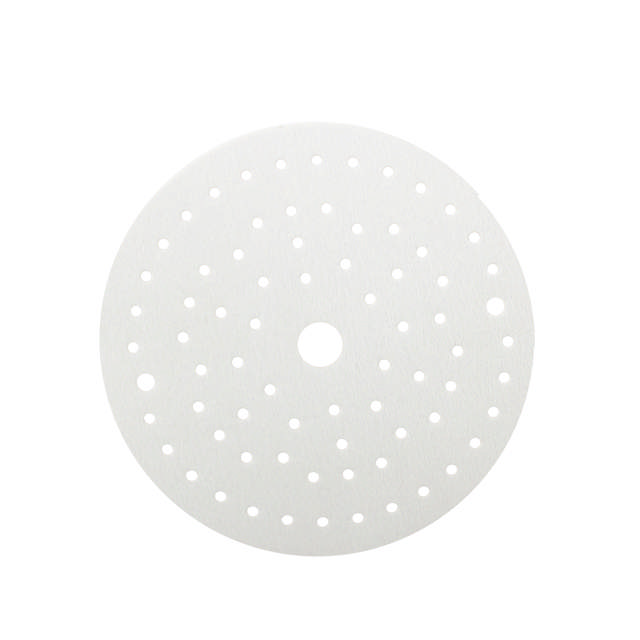
Paint Preparation Abrasive System
Refines the surface and combines multiple sanding stages into one controlled pass, reducing process time while improving finish quality.

Abrasive Purple Discs - Ceramic
Delivers fast, controlled cut with optimised dust extraction, helping reduce clogging and maintain a more consistent scratch pattern.
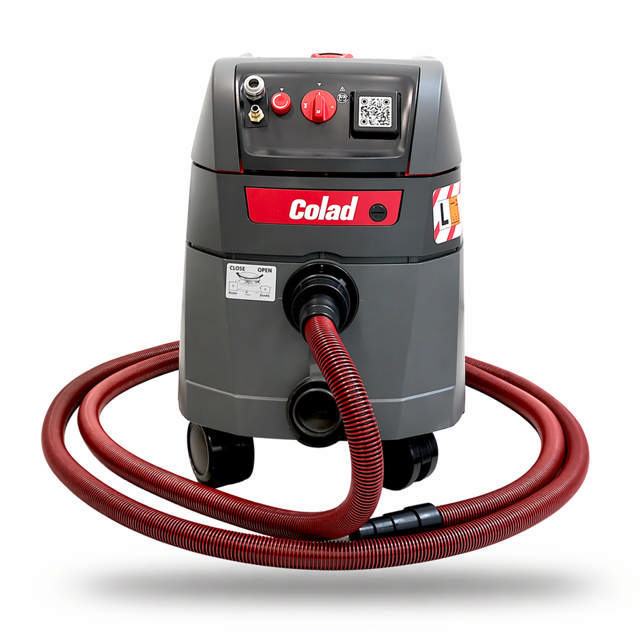
Mobile Vacuum Cleaner CMV 8-M EA/PA
Captures dust at source at the workstation, helping keep the repair area cleaner and lowering recontamination risk during sanding.
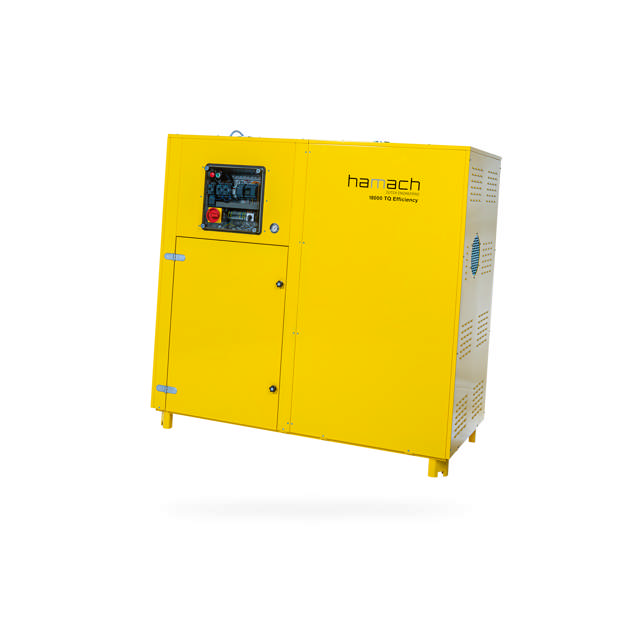
Dust Extraction System HCV 5000 TQ
Provides continuous central extraction across multiple tools and workstations, supporting a stable, high-throughput sanding process.
Improve another part of your repair process
From surface preparation to final finish, explore connected workflows designed to reduce rework, standardise technique and recover time across the shop.


Workflow Academy: Learn from real bodyshop workflows
Watch practical process demonstrations, sanding techniques and product applications that help technicians work cleaner, faster and with more consistency.